Germany has a long, well-documented history with Turkey — and that relationship is very much alive on university campuses across the country. Germany is home to the largest Turkish community in Europe, with approximately 1.5 million Turkish citizens currently residing there and a broader population of Turkish origin close to 3 million.
For a student moving from İstanbul or Ankara, that’s not a small thing. There are familiar restaurants, Turkish-speaking neighbourhoods and established student networks waiting.
This guide covers everything: the education system, the cost of studying in Germany for Turkish students, how to navigate the visa process, what programmes make sense for your career and what student life actually looks like day to day.

Why Study in Germany for Turkish Students
A ready-made community. Berlin alone has around 191,000 residents of Turkish origin — the largest Turkish community outside of Turkey. You won't be starting from zero socially.
Post-study work rights. After graduation, you can stay in Germany for up to 18 months on a job-seeker residence permit to find skilled employment.
Degrees recognised worldwide. German private university qualifications accredited by bodies like the Wissenschaftsrat — carry genuine weight with employers globally.
English-taught programmes. At private universities like UE Germany, the majority of programmes are delivered in English, so language isn't a barrier to entry.
Career-focused learning. German universities of applied sciences are structured around real industry experience — not just theory.
For many Turkish students, Germany isn't just a place to study. It's a place to build a career.
German Education System Explained for Turkish Students
The German higher education system can look a little different from what students in Turkey are used to, so it’s worth a quick breakdown.
Germany has two main types of higher education institutions: traditional universities (Universitäten) focused on academic research, and universities of applied sciences (Fachhochschulen or Hochschulen), which take a more practical, career-facing approach. The University of Europe for Applied Sciences (UE Germany) sits in the latter category, it’s a state-accredited private university of applied sciences, which means its degrees are officially recognised across Germany and internationally.
Programmes follow the Bologna system — the same framework used across Europe — so Bachelor’s degrees typically run three years and Master’s degrees between one and two years. This makes transferring credits from a Turkish university relatively straightforward.
One thing worth knowing: at private universities, tuition fees do apply. That’s a normal and expected part of studying at an institution like UE Germany. What you get in return — smaller classes, industry partnerships, English-language delivery, international campuses — reflects that investment.
Best Courses to Study in Germany for Turkish Students
The best courses in Germany for Turkish students tend to be those with strong European employer demand and genuine career pathways. At UE Germany, the most popular areas among international students include:
- Business Administration: available at Bachelor’s and Master’s level, with specialisations in marketing, entrepreneurship, finance and management
- Art & Design: including communication design, Game Design and Photography, delivered from the Berlin campus.
- Psychology: increasingly in demand across European markets
- Sports & Event Management: with unique access to industry partnerships.
- Technology & Innovation —with a focus on digital and applied tech.
For students interested in business studies in Germany for Turkish students, UE’s business programmes are particularly well-regarded — the university has received the German Education Award 2024/2025 for excellence, and its business graduates benefit from an exclusive international collaboration including Amsterdam Shorts Week, an international short-term learning experience in the Netherlands.
To study a Master’s in Germany for Turkish students, the requirements typically include a relevant Bachelor’s degree, proof of English proficiency (IELTS 6.0–6.5 for English-taught programmes), and a strong motivation letter. Some programmes require a portfolio or aptitude test — especially in creative disciplines.
Admission Requirements for Turkish Students
Academic requirements for Turkish students in Germany at universities like UE are structured but accessible. Here’s what you’ll generally need:
For Bachelor’s programmes:
- A recognised secondary school qualification — your Lise Diploması (Turkish high school diploma) qualifies, though some programmes may require an equivalency evaluation (Anabin check or Studienkolleg preparation).
- English proficiency: IELTS 6.0 or equivalent (TOEFL, Duolingo).
- A completed application form and motivation letter.
- In some cases, a portfolio (for design programmes) or an entrance assessment.
For Master’s programmes:
- A Bachelor’s degree in a relevant field.
- Academic transcripts.
- IELTS 6.5 or equivalent.
- CV and motivation letter.
- References may be requested.
Cost of Studying in Germany for Turkish Students
The cost of studying in Germany for Turkish students at a private university varies by programme and campus. At UE Germany, tuition fees are structured per semester, and private university fees in Germany typically range from €5,000 to €20,000 per year depending on the programme and institution.
Here’s a realistic breakdown of study-related annual costs at a private university:
| Cost Item | Approximate Annual Cost |
| Tuition fees (private university) | €5,000 – €20,000+ |
| Semester administration fee | €300 – €800 |
| Study materials & books | €200 – €600 |
| Health insurance (under 30) | €1,500 – €1,800 |
Scholarships are available. UE Germany offers several, including the Digital Pioneers Scholarship (full tuition) Cultural Diversity Scholarship and Siblings & Spouses Scholarship, among others. Click on the link here or check directly with the admissions team for current availability and eligibility.
Cost of Living in Germany for Turkish Students
The cost of living in Germany for Turkish students will vary considerably depending on which city you choose. As a guide:
| Expense/City | Munich | Berlin | Cologne | Hamburg | Frankfurt |
| Rent (one bedroom, city centre) | €1,537 | €1,195 | €1,076 | €1,166 | €1,301 |
| Rent (one bedroom, outside city centre) | €1,191 | €889 | €842 | €826 | €1,019 |
| Meal for two people (mid-range restaurant) | €80 | €65 | €75 | €80 | €80 |
| Meal for one at a cheaper restaurant | €19 | €15 | €14 | €18.00 | €15 |
| Grocery bill* | €33.44 | €33.77 | €35.58 | €33.37 | €35.59 |
| Utilities (85m2) | €341.38 | €316.56 | €349.42 | €315.04 | €317.28 |
| Taxi start, regular tariff | €5.70 | €5 | €4 | €6.00 | €4 |
| Gym | €43.81 | €33.33 | €38.18 | €42.59 | €61.72 |
For visa purposes, the German government sets the baseline at €992 per month (€11,904 per year), which must be held in a blocked account (Sperrkonto). In practice, most international students spend between €850 and €1,300 per month on all expenses combined.
Shopping at Aldi, Lidl, or Netto rather than premium supermarkets, cooking at home and taking advantage of university Mensa (canteen) meals, which run €2–€5 per plate, make a significant difference to monthly spending.
Germany Student Visa Process for Turkish Students
The Germany student visa process for Turkish students involves a few specific steps that differ slightly from other nationalities. Here’s what to know.
Turkish citizens need a National Visa (Type D) — the Visum zu Studienzwecken — to study in Germany for programmes longer than 90 days. This is non-negotiable, and the application process runs through iDATA, Germany’s official external service provider for visa applications in Turkey.
How to Get a Germany Student Visa from Turkey
The process breaks down as follows:
- Get your admission letter — you need an official Zulassungsbescheid from a state-recognised German university before applying.
- Create your account on the Consular Services Portal — German missions in Türkiye now use a digital portal for preliminary document review before your in-person appointment.
- Upload your documents digitally — this includes your passport, admission letter, proof of funds, health insurance and language certificates
- Await preliminary review — a visa officer checks your file for completeness before you book your in-person slot.
- Attend your iDATA appointment — bring originals and two copies of all documents; biometrics (photo and fingerprints) are taken here.
- Pay the visa fee — €75 for the student visa, plus an iDATA service fee of approximately €32.81 (payable in Turkish Lira).
Register on arrival — once in Germany, register your address within two weeks and apply for a residence permit at the local Ausländerbehörde.
Visa requirements for Turkish students in Germany in terms of documentation include:
- Valid passport (minimum 12 months validity remaining).
- Official university admission letter.
- Proof of financial means — either a blocked account (Sperrkonto) showing €11,904, a formal Letter of Commitment (Verpflichtungserklärung) from a German resident, or a scholarship letter.
- Health insurance certificate (or an AT/11 document if covered under the Turkish Sosyal Güvenlik Kurumu).
- Lise Diploması or Bachelor’s degree certificate.
- Language proficiency certificate (IELTS/TOEFL for English programmes).
- Motivation letter.
A useful shortcut for Turkish students: if you or a family member is covered under the SGK, you may be eligible for an AT/11 Foreign Health Insurance Certificate, which satisfies the health insurance requirement without purchasing additional coverage — potentially saving over €1,300/year. Full details are available via VisaFlow’s guide.
Processing time: Plan for at least 3 months from application submission. The preliminary review and appointment scheduling add time, so apply as early as possible.
Part-Time Work Opportunities & Career Prospects in Germany
Can Turkish students work while studying in Germany? Yes — and many do. International students are permitted to work up to 140 full days or 280 half days per year, or up to 20 hours per week during term time. That’s enough to cover a meaningful portion of living expenses.
Common student jobs include campus assistant roles, retail, hospitality, tutoring, and increasingly, digital freelance work. In Berlin, Hamburg, and other major cities, English-language work is far easier to find than in smaller towns — another advantage of studying at UE’s urban campuses.
On the career side, Germany is ranked #4 Worldwide for Work–Life Balance (2025), with the German government planning to invest up to €120 million through 2028 to support international graduates, improve student services and offer career transition support and German language training.
Sectors actively recruiting include technology, engineering, finance, marketing, and creative industries — all areas where UE graduates concentrate. After completing your degree, the 18-month post-study residence permit gives you real time to secure a position without pressure — combine that with 90% of UE graduates securing jobs shortly after graduation, and you have a real shot at excelling in the job market.
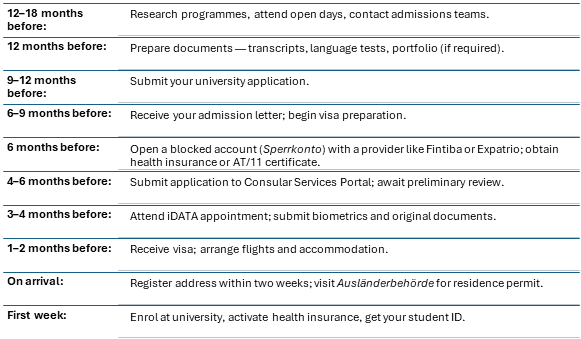
Step-by-Step Timeline to Study in Germany
A rough 12–18 month timeline for how to apply to German universities from Turkey:
Common Challenges Turkish Students May Face in Germany
Being prepared for the difficult parts is just as important as being excited about the opportunities. Here are the most common friction points — and how to navigate them:
- Bureaucracy. German administration is thorough and paper-heavy. The iDATA process, blocked account setup, registration, and residence permit application all require patience. Start early and keep digital copies of everything.
- Language. Daily life in Germany is still largely conducted in German, even if your programme is in English. Basic German — even at A2 level — will help enormously with finding accommodation, opening a bank account and navigating public services. Most universities offer free German courses for international students.
- Housing. This is arguably the biggest practical challenge, particularly in Berlin and Hamburg. Student housing (Studentenwohnheim) is limited. Applications should go in the moment you receive your admission letter.
- Financial planning. The blocked account requirement means locking away €11,904 upfront. Factor in the time needed to arrange this into your preparation timeline.
How to Choose the Right Programme at UE Germany
There’s no single right answer here — it depends on your goals. A few things worth thinking through:
What industry do you want to work in? UE’s strength is in business, creative disciplines, technology, sport and psychology. If your long-term goal is working in finance, media, marketing, or design in Europe, you’re in the right place.
Which campus suits your lifestyle? The Berlin campus is creative, urban, and well-connected to industry hubs. Hamburg leans towards entrepreneurship and business. Potsdam focuses on tech and digital innovation. Iserlohn, UE’s original campus, specialises in sport and health. Each has a distinct character.
Do you want to study in English? All UE campuses offer English-taught programmes — this is one of the reasons UE specifically attracts international students who may not yet speak German.
What do you want from the university experience? UE is intentionally career-facing. There are mandatory industry placements, real-world projects and corporate partnerships built into programmes. If you want a structured, research-led academic environment, a traditional German research university might align better.
Accommodation Options in Germany for Turkish Students
Student accommodation in Germany for Turkish students broadly falls into three categories:
- Student halls (Studentenwohnheim) — the most affordable option, run by the Studentenwerk (student services organisation). Costs range from €200 to €400 per month and often include utilities.
- Shared flats (WGs — Wohngemeinschaft) — the most popular choice among students. Rooms typically run €300 to €600 per month depending on the city. Platforms like WG-Gesucht.de and Facebook groups are the primary search tools.
- Private apartments — the most expensive option, starting from €500–€1,200 per month in most cities.
For Turkish students, the large Turkish communities in Berlin (particularly Kreuzberg and Neukölln) and other cities mean there are well-established informal networks for finding flatmates and recommendations. These shouldn’t be underestimated — word-of-mouth still works very well in Germany’s tight rental market!
Conclusion
Germany is one of the most pragmatic choices a Turkish student can make. The cultural ties are genuine, the post-study work options are real and the qualification you earn carries weight. At UE Germany specifically, the combination of English-taught programmes, career-focused learning and campuses in Germany’s most active cities makes for an experience built around what comes after the degree, not just the degree itself.
Getting there requires planning — the visa process, the blocked account, the housing search. None of it is complicated once you know the steps, but each piece needs time. Start earlier than you think you need to.
FAQ's
Here are Some Other Blogs You'll Find In
Top 25 Most Asked FAQs About Studying in Germany – Explore Now!
10 Best Cities in Germany for International Students and Job Seekers
The Cost of Studying in Germany: A Guide for International Students
How to Work in Germany During or After Your Studies
How to Select the Best Master’s Programme in Germany for International Students