Read everything that distinguishes us as a system-accredited private university and how we constantly develop and review our quality.
The University of Europe for Applied Sciences (UE) is among the first private universities in Germany to have successfully achieved system accreditation. This status highlights the effectiveness of our quality management system (QMS) for teaching and learning, which is based on clearly defined, interlinked processes and is continuously adapted to the university’s evolving needs. The Staff Unit for Higher Education Development and Quality Management (HEQM) is responsible for overseeing and further developing these processes in line with current legal requirements, as well as for conducting accreditation procedures. It ensures that UE consistently meets the high standards set by the German Accreditation Council and that its commitment to quality in teaching and learning is systematically upheld.
Quality at UE
Quality at UE is consistently guided by the student experience. At its core is a holistic understanding of studying, encompassing all phases and conditions – from application and enrolment through to graduation and the alumni phase.
At UE, quality in particular means that:
degree programmes are developed and reviewed through clearly defined processes, ensuring that students who successfully complete their studies at UE are awarded a state-recognised Bachelor’s or Master’s degree,
the study portfolio is continuously enhanced, with programmes undergoing a quality review cycle (programme cycle) at least every three years or on an ad hoc basis, and a comprehensive reaccreditation after a maximum of eight years,
teaching and learning are systematically designed and improved from the students’ perspective,
various stakeholders within and outside the university contribute jointly to quality assurance,
standardised procedures are combined with flexibility to allow for innovation and discipline-specific characteristics,
a transparent culture of communication and participation forms the foundation of quality development.
UE’s quality management system combines central coordination with decentralised responsibility and takes into account the specific characteristics of different faculties and campuses. Quality is understood as a shared responsibility of all members of the university.
The foundation of the quality management system is the university’s mission statement, which was revised in 2025 in response to the expansion of the study portfolio as well as new societal and technological challenges, along with the derived quality objectives. These provide clear guidance for ensuring and further developing teaching and learning, while also supporting graduates’ employability and long-term career success.
UE sees itself as a continuously evolving institution. Quality is not only measured against external standards but is actively shaped. In addition to teaching and learning, organisational frameworks are also systematically integrated into quality development in order to ensure sustainable, high-performing, and future-oriented study programmes.
The implementation of quality objectives follows clearly structured processes based on the entire lifecycle of study programmes (programme life cycle) as well as the student experience (student life cycle). This ensures both the strategic development of the study portfolio and the continuous improvement of study conditions.
All quality management processes are described in detail in UE’s Quality Handbook.
UE’s quality management is based on the university’s mission statement:
Mission Statement of the University of Europe for Applied Sciences
The University of Europe for Applied Sciences (UE) prepares its students for responsible roles in business, design, technology, psychology, health, and sport. Our interdisciplinary study programmes equip students with professional, social, and methodological competencies tailored to the demands of a globalised, digital, and dynamic working and living environment.
As an agile private university, UE actively shapes the future of academic education. We develop flexible study formats that respond to societal and economic transformation processes, fostering entrepreneurial thinking and creative action. At the same time, we place strong emphasis on the individual development of our students – through reflective personal growth, social engagement, and a clear commitment to democratic values, as well as openness to diversity and change.
UE sees itself as both internationally connected and locally rooted. In the context of a globalised educational landscape and a diverse international student body, we redefine internationality – not as an optional add-on, but as a structural foundation of our teaching, research, and institutional development.
At UE, diverse perspectives, cultures, and experiences come together to generate new ideas, foster creative solutions, and enable our graduates to pursue successful, future-oriented careers. Our university stands for up-to-date, practice-oriented content that continuously evolves and adapts to real-world requirements.
Our ambition is to provide excellent, relevant, and future-focused education for a connected world – shaped responsibly together with our students, academic staff, and partner institutions.
Through an interactive, interdisciplinary, and international approach, we prepare our students to actively, responsibly, and creatively shape the world of tomorrow – in business, healthcare, the digital economy, and creative industries.
We create an agile and creative learning environment that responds to current societal, technological, and economic challenges and empowers individuals to actively shape the future.
Our approach to teaching, research, and collaboration is guided by the following core values:
Diversity
UE is a place where people from diverse social, cultural, and geographical backgrounds learn and grow together. We embrace different perspectives as a valuable resource for collaborative learning, teaching, and creative development.
Openness
We foster a culture of curiosity, diversity of opinion, and interdisciplinary exchange across academic and cultural boundaries. Critical thinking and a willingness to learn from one another shape our community.
Responsibility
We encourage reflective action in studies, professional life, and society. Our focus lies on ethical and human-centred technology development, sustainable entrepreneurial impact, and responsible design.
Sustainability
We promote awareness of economic, social, and ecological interconnections. Sustainability is a cross-cutting theme in our teaching and research, supported by an international community that critically reflects on and actively contributes to global and local transformation processes.
Interdisciplinarity
Our programmes combine entrepreneurial thinking, technological expertise, and creative excellence. This enables solutions that are economically viable, technically sound, and human-centred – forming the basis for addressing complex challenges holistically.
Innovation
We continuously rethink education and actively shape digital, technological, and social transformation. At the intersection of business, technology, and design, we build on current academic discourse and emerging didactic approaches.
Practical Relevance
We firmly anchor our teaching and research in real-world practice. Project-based learning formats, research-driven collaboration, and close partnerships with companies, universities, cultural institutions, and public stakeholders ensure strong practical connections. We combine global perspectives with regional impact to make knowledge immediately applicable and to drive innovation in society and the economy.
Didactic Excellence
Our teaching concepts combine academically grounded didactics with practical, interactive learning formats. We emphasise project-based learning, research-oriented tasks, and interdisciplinary collaboration to ensure sustainable knowledge transfer and targeted competence development. Our lecturers apply innovative methods and continuously refine their didactic approaches through exchange with internal and external experts.
Structure of the Quality Management System for Teaching and Learning at UE
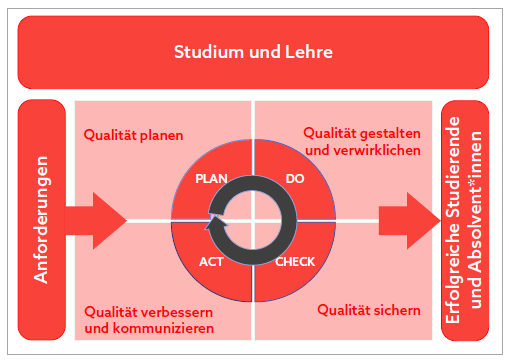
UE’s quality management system follows a closed-loop cycle based on the PDCA model (Plan, Do, Check, Act), the functioning of which is monitored by the Staff Unit for Higher Education Development and Quality Management (HEQM).
Quality planning at UE is based on a clearly defined educational profile and binding quality objectives for teaching and learning. Together, they form the strategic framework for the development, implementation, and continuous enhancement of all study programmes.
Educational Profile: Practice-Oriented, Innovative, and International UE’s educational profile is shaped by the interplay of creativity, technological expertise, and entrepreneurial thinking. The aim is to prepare students for the demands of a dynamic and global labour market while actively supporting their individual competence development.
Practical relevance is reflected in application-oriented teaching content, project-based learning, and close collaboration with companies and industry partners, Innovation is ensured through the continuous development of study programmes based on market and trend analyses, evaluations, and external feedback, Internationality is an integral part of all programmes and is reflected in international partnerships, a diverse student body, and English-language offerings.
Diversity, inclusion, and equal opportunities are core principles at UE and are integrated into all areas of teaching and learning – from programme development and teaching practice to evaluation and improvement processes.
A key instrument for ensuring equal opportunities is the provision of reasonable accommodations (“compensation for disadvantages”). These enable individual adjustments in studies and examinations to appropriately consider different life circumstances and disabilities.
Quality Objectives for Teaching and Learning Based on its mission statement and educational profile, UE defines university-wide quality objectives that serve as a binding reference framework for all study programmes. These aim to:
- prepare students for a global, digital, and dynamic environment, - foster critical thinking and responsible action, - strengthen interdisciplinary, practice-oriented, and innovative learning formats, - support individual competence development and personal growth, - systematically integrate international and diverse perspectives. These quality objectives create transparency regarding expectations for study programmes and form the basis for their continuous development.
The introduction of a new study programme at UE follows a transparent procedure divided into four distinct phases.
First Filter Phase The development of new study programmes at UE begins with the first filter phase. Ideas from the faculties are collected, discussed within the relevant committees, and evaluated based on key criteria. The aim of this phase is to assess the feasibility and potential success of a programme at an early stage. Based on this evaluation, a decision is made as to whether the concept should be developed further.
Programme Development Phase During the programme development phase, the study programme concept is developed in terms of both content and structure. The Staff Unit for Higher Education Development and Quality Management (HEQM) supports this process in an advisory capacity.
To ensure feasibility, the concept is then coordinated with the relevant service units. Both academic and administrative aspects are reviewed, and the results are formally documented. This phase concludes with the submission of a project dossier, which consolidates all key information about the programme. Based on this, the Extended University Management decides whether to initiate the internal accreditation procedure.
Accreditation Phase Based on the submitted programme documentation, the study programme undergoes a formal, academic, and content-related review in accordance with the university’s internal quality criteria. As a system-accredited university, UE conducts the accreditation of its programmes independently, following a clearly defined procedure in line with applicable legal requirements. The accreditation process begins with the approval of the project dossier by the Extended University Management. After the accreditation seal has been awarded, the Staff Unit HEQM prepares the accreditation report.
Post-Accreditation Phase Following a positive accreditation decision by the Presidential Board, the study programme enters the final phase of implementation and continuous development.
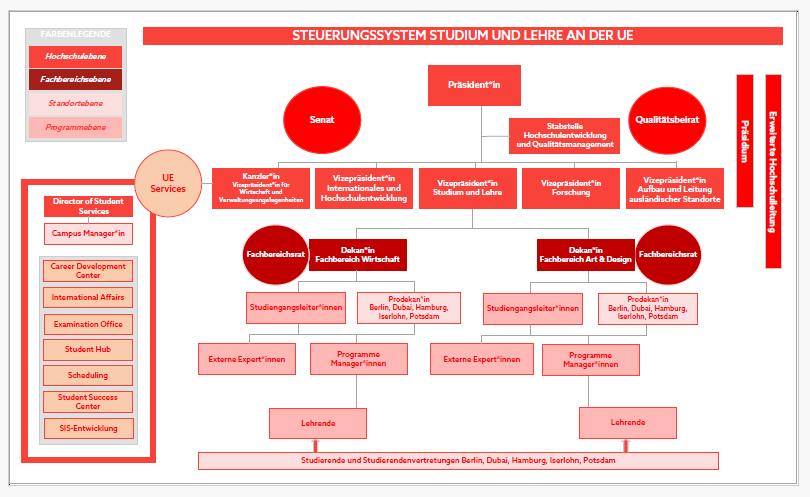
Quality Governance at University Level The central leadership and governance bodies of UE shape the university’s strategic direction and oversee its continuous development. They make fundamental decisions regarding teaching, learning, research, as well as organisational and structural matters.
These bodies include: - the Presidential Board - the Extended University Management - the Senate - the Quality Advisory Board
They are supported by the Staff Unit HEQM, which ensures the functionality and implementation of the quality management system.
At UE, quality is ensured through the interaction of various instruments. These make it possible to continuously monitor, reflect on, and systematically improve teaching and learning, as well as service and support structures. Quantitative data and qualitative feedback are meaningfully combined and utilised throughout the entire student lifecycle.
Qualitative data is primarily collected through surveys conducted as part of evaluation processes, as well as through the assessment of study programmes by external experts during programme development. The collection and provision of quantitative data are summarised under the term academic controlling.
Binding regulations and clearly defined procedures provide the organisational foundation for sustainable implementation.
Quality assurance at UE is based on the use of reliable evaluation data. Within its quality management system, the university employs a wide range of instruments that incorporate different perspectives. The foundation is an evaluation policy adopted by the Senate, which defines the objectives, responsibilities, and procedures for evaluation in a binding manner.
Study programmes at UE are continuously developed to meet current requirements and the needs of students. To further enhance teaching quality and strengthen academic and pedagogical competencies, UE offers a wide range of initiatives:
- the Teaching Award, which recognises innovative and outstanding teaching performance, - diversity and inclusion initiatives to raise awareness of different learning needs, - peer observation formats as a voluntary opportunity to reflect on and further develop individual teaching methods, - digital professional development platforms offering flexible training in areas such as didactics, higher education teaching, digitalisation, leadership, and communication, - participation in ERASMUS-funded international staff mobility, - language courses (German and English) for all staff members.
Teaching Development Dialogues Teaching development dialogues are a mandatory instrument for quality-oriented teaching and staff development. Participants: Vice Deans Programme Directors Frequency: As required Trigger: If a lecturer’s overall evaluation falls outside the defined quality standards, or remains within the tolerance range for two consecutive semesters, a teaching development dialogue is conducted.
Quality Circles Quality circles are dialogue-based evaluation formats that place the student experience at the centre. They focus on teaching and learning, study conditions, as well as service and support structures. At UE, quality circles take place on two levels: campus-level circles review the situation at individual campuses annually, while programme-level circles focus on the further development of individual study programmes. Their specific design follows internal university guidelines.
Campus Quality Circles Responsible: Presidential Board Chancellor Participants: Student representatives Campus Managers Vice Deans Director of Student Services Anti-Discrimination Officer Equal Opportunities Officer Representative for members and affiliates with disabilities Implementation: HEQM or Evaluation Officer Frequency: Once per year
Programme Quality Circles Responsible: Presidential Board or Vice President for Teaching and Learning Participants: Programme Directors Students Vice Deans Lecturers Alumni External experts Industry partners (for dual study programmes) Implementation: HEQM or Evaluation Officer Frequency: Every three years, or as required, and at least twice within the accreditation cycle
Regular reporting within the university’s internal committees ensures transparency and supports the continuous development of teaching and learning. By systematically compiling and structuring relevant information, quality-related issues are identified at an early stage, enabling well-informed coordination and decision-making processes.
Quality and success
UE’s QM system makes a decisive contribution to the success of our studies and the satisfaction of our students. Closely related to this is the satisfaction of our teaching and administrative staff. The university management recognises this and applies the same quality standards to itself as an employer as it does in its dealings with the university’s students.