Germany has built a reputation for engineering excellence, precision planning, and strong business leadership. It’s no surprise that professionals looking to move into leadership roles are turning their attention to an MBA in Project Management in Germany.
For ambitious graduates and young professionals, this qualification bridges business strategy with execution. And in a market where organisations are under pressure to deliver complex projects on time and within budget, the demand for project managers continues to grow across industries.

What is a Project Management MBA?
In simple terms, it prepares you to:
Lead cross-functional teams.
Manage budgets and timelines.
Oversee risk and compliance.
Align projects with long-term business strategy.
Unlike a purely technical project management course, an MBA focuses on leadership and commercial thinking.
According to the Project Management Institute (PMI), employers will need 30 million new project professionals by 2035 to meet global demand. This talent gap is one reason why an MBA in Project Management remains important in 2026.

Who Should Choose an MBA in Project Management?
You should seriously consider this path if you:
Have 2–5 years of professional experience and want to move into leadership.
Are working in construction, tech, consulting, healthcare, or manufacturing — industries where projects are the backbone of operations.
Want to combine business strategy with practical project delivery skills.
Are an international student looking for a European qualification that opens doors across German-speaking markets and beyond.
Are currently in a coordinator or analyst role and want a credible pathway to senior management.
If you enjoy organising teams, solving operational challenges, and taking responsibility for outcomes, this path fits you naturally.
MBA in Project Management: Course Structure & Subjects
A typical project management course at the MBA level is structured to move from business fundamentals in the early stages towards specialised project management modules, leadership development, and a capstone or thesis.
While programmes vary by institution, most universities in Germany structure the curriculum around:
| Core MBA Modules | Specialised Project Modules |
| Strategic Management Financial Decision-Making International Marketing Business Economics Corporate Governance | Project Planning and Control Agile and Scrum Methodologies Risk and Quality Management Leadership in Project Environments Digital Transformation Projects |
Students often work on live case studies and simulations that mirror real-world business environments — a huge advantage for those planning a career after an MBA in Project Management.
MBA in Project Management vs MSc in Project Management: Which Is Better?
The MBA vs MSc in Project Management debate comes up constantly, and the honest answer is: it depends entirely on where you are and where you want to go.
Here is a straightforward comparison:
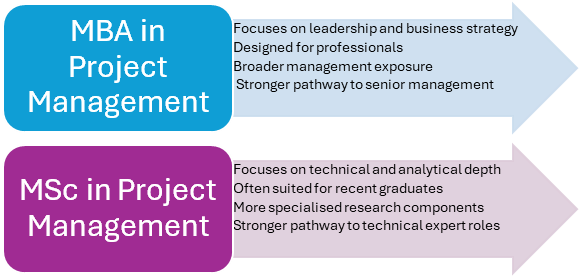
If your goal is to lead departments, manage P&L responsibility, or move into C-suite territory, the MBA tends to carry more weight in the market.
If you want to become a project delivery specialist within a technical environment, the MSc may serve you better.
Career Scope & Salary After an MBA in Project Management
The scope of an MBA in Project Management isn’t just broad; it reflects a real shift in how organisations operate. Every industry now runs on projects. Product launches, digital transformations, sustainability initiatives, market expansions — they’re all structured, budgeted, and measured as projects.
You can see this momentum clearly in the numbers, with more than 1.8 million individuals holding PMI certifications, and learners opening over 700,000 PMI certification applications each year. Those figures don’t point to a passing trend. They show a sustained, global demand for people who know how to plan, coordinate, manage risk, and deliver results under pressure.
In Germany specifically, salaries for MBA-qualified project managers are competitive. Salary levels vary by industry, company size, and location — Berlin, Hamburg and Munich tend to offer higher compensation than smaller cities.
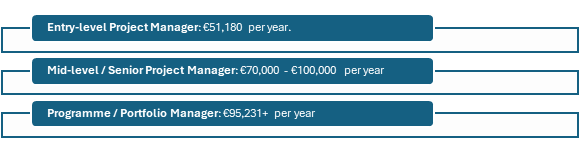
But across the board, the demand for project managers in Germany remains strong, driven by digitisation programmes, infrastructure investment, and the ongoing shift towards agile organisations.
Top Job Roles After an MBA in Project Management
Graduates typically secure roles such as:
- Project Manager.
- Programme Manager.
- Operations Manager.
- IT Project Lead.
- Supply Chain Manager.
- Business Transformation Consultant.
Search trends around project management MBA jobs indicate strong cross-sector mobility, particularly within international firms operating in Germany.
Industries Hiring MBA Project Management Graduates
The question is no longer whether companies need project managers — it’s where they need them most.
Sectors hiring Project Managers in Germany:
- Automotive (Volkswagen Group, BMW ecosystem).
- FinTech and Banking.
- E-commerce.
- Green Energy and Sustainability.
- HealthTech.
Germany’s strong Mittelstand (SME) structure means many mid-sized companies seek leaders who understand both operations and growth strategy.
Skills You Gain from an MBA in Project Management
Beyond theory, students build essential leadership skills in Project Management, including:
- Strategic decision-making.
- Budget forecasting.
- Risk mitigation.
- Cross-cultural communication.
- Stakeholder negotiation.
- Agile execution.
These skills increase your mobility across sectors and countries. Employers increasingly value managers who combine technical awareness with financial literacy. That balance is exactly what an MBA delivers.
Why Choose UE Germany for an MBA in Project Management?
Choosing where to study MBA in Project Management in Germany matters as much as choosing the degree itself.
The University of Europe for Applied Sciences (UE) is a well-established private university in Germany, with campuses in Berlin, Hamburg, Potsdam, and Iserlohn. Choosing an MBA in Project Management at UE means stepping into a learning environment shaped by real business practice.
What sets UE’s MBA programme apart:
- Become a confident, job-ready project leader: Gain practical, hands-on experience with real-world tools, methods and frameworks used in modern project management.
- Practice-driven learning from day one: Work on analysing and improving real project strategies within organisations.
- Specialised modules that build leadership skills: Deepen your knowledge in Project Management and Leadership and Cross-cultural Management, preparing you to lead diverse teams and manage global projects with confidence.
- Flexible blended learning format: Core MBA modules are delivered on campus, while specialised modules are taught online.
- Career-focused curriculum across industries: Gain skills relevant to fast-growing sectors such as finance, SaaS, music, e-commerce and digital innovation.
- Study in two international business hubs: Choose between Berlin or Dubai and benefit from strong startup ecosystems, global networks and exposure to large-scale, innovative projects.
- Strong career support and professional guidance: Access personalised support through UE’s Career Development Centre, including career coaching, CV preparation and job search guidance.
For international students specifically, UE offers a structured pathway into the German professional market — including guidance on post-study work visa options under Germany’s Skilled Immigration Act (Fachkräfteeinwanderungsgesetz), which actively encourages qualified graduates to remain and work in Germany after completing their studies.
Conclusion: Is an MBA in Project Management Worth It?
The short answer: yes — provided you choose the right programme and go in with clear professional goals.
The demand for project managers is not a passing trend. Organisations globally are managing more complexity, more change, and more interdependency than at any previous point. An MBA in Project Management in Germany positions you at the centre of that movement. It offers:
- Strong earning potential.
- Cross-border career flexibility.
- Leadership acceleration.
- Industry mobility.
For professionals ready to move beyond execution and into decision-making, the return on investment can be significant.
FAQ's